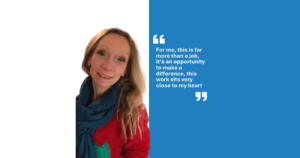
Care Plus Group is proud to celebrate the national-level work of our very own Vicky Henderson, whose expertise, determination and collaborative approach are helping to improve moving and handling practice across health and social care.
Vicky has been working alongside professionals from a range of organisations and moving and handling backgrounds after concerns emerged around the use of slings during patient transport and the significant impact this was having on safety, dignity and access to care.
Understanding the issue, it is sometimes appropriate to say that wheelchair users should not travel with a sling in place. However, the challenge arose when this message became over‑simplified and inconsistently applied in practice.
Following a small number of regional incidents involving wheelchair users sliding out of chairs, further investigation uncovered a wider issue. In some cases, patients were missing healthcare appointments altogether because services were unsure whether it was safe or acceptable for individuals to travel with a sling.
Missed appointments placed patients’ health and wellbeing at risk and created situations that were neither dignified nor person‑centred. Too often, the issue was attributed solely to “the sling”, rather than exploring when sling use may be appropriate within the wheelchair and when it is not.
A real‑life example
One particularly powerful case study involved a patient with a spinal cord injury who was independent with hoisting and able to self‑hoist safely when their sling could remain in their chair.
When attending hospital appointments, the patient was usually transported in a wheelchair, with their sling left in situ. However, a change in the system resulted in the patient being refused wheelchair transportation and offered a stretcher as the only option to access their appointment. This system change significantly restricted patient comfort, positioning and independence, and the experience was described as debilitating. As discussions progressed, it became clear that increasing numbers of patients were being affected by this issue.
Crucially, the presence of a sling (including in-situ designs) in a wheelchair was frequently cited as the reason for services refusing transportation, and, in the absence of clear evidence or guidance to support decision‑making, this appears to have led to a more cautious, standardised approach being implemented rather than decisions based on individual risk assessment.
Turning gaps into guidance, Vicky worked to benchmark practice across services and carried out research to identify existing national guidance. What became apparent was that no clear, consistent guidance existed to support staff in deciding when it is appropriate or not appropriate for a person to travel with a sling in place.
In response, Vicky joined colleagues from different organisations to form a small national working group. Together, they developed a clear, easy‑to‑read guidance document designed to support anyone involved in moving and handling decisions.
The document sets out:
- When it may be appropriate for someone to travel with a sling
- When it is not appropriate
- Key considerations around dignity, safety, independence and risk
- The importance of individualised assessment rather than blanket rules
The aim was to share expertise to support safer, more informed practice and to reduce missed appointments caused by uncertainty.
National recognition and growing impact: This work was initially presented at the National Back Exchange (NBE) conference and subsequently led to an invitation to deliver a national NBE webinar, where Vicky and colleagues shared the project and emerging learning with a wider audience. The guidance documents and webinar recording remain available to members via the NBE website.
The guidance has undergone peer review through the National Back Exchange, Loughborough Alumni Research Forum (LARF) and other M&H experts, providing professional scrutiny and supporting its credibility and relevance. The associated documents are available via the NBE website.
The guidance document is now being considered, showcased, and adopted across a range of services including by the Scottish Ambulance Service and Yorkshire Ambulance Service, with further engagement ongoing across the UK. A national meeting is planned later in the year to support continued collaboration, consistency in approach and shared learning. The work is ongoing with plans to develop a guidance document for sling prescribers.
Influencing safer practice at a national level, this work demonstrates the power of working together, sharing expertise and challenging assumptions. By addressing a real and under‑recognised issue, Vicky has helped influence change that improves safety, dignity, and access to care for patients nationwide.
Care Plus Group is incredibly proud of Vicky’s contribution and the national impact of her work, a fantastic example of how colleagues can drive meaningful change far beyond our organisation.